Trading
Options Trading Accelerator Mentorship (2026)
Transforming Trading Workflows Through Front-End Engineering & Data-Driven Decision Making
A six-month, one-on-one mentorship focused on options trading, risk management, and process optimization that inspired the development of multiple web-based decision-support tools.
Interview
As part of completing the mentorship, I participated in an interview with Damaris discussing my experience throughout the program, the evolution of my trading process, and the front-end tools I developed during the mentorship. The conversation explores how engineering principles—automation, systems thinking, and iterative improvement—can be applied to options trading.
Overview
The Options Trading Accelerator (OTA) is a one-on-one mentorship led by professional options trader Damaris Avila, designed to help traders develop a structured, repeatable approach to options trading through personalized coaching, trade reviews, chart analysis, and risk management.
I joined the program to improve my consistency as a trader, but it quickly became much more than a trading course. It became an opportunity to apply my front-end engineering background to solve real-world workflow problems. Throughout the mentorship, I analyzed my own trading data, identified recurring inefficiencies, and designed software tools that transformed manual calculations into fast, repeatable decision-support systems.
The result was not only significant growth in my trading process, but also the creation of several web applications and planning frameworks that improved consistency, reduced cognitive load during live market conditions, and were shared with other students in the mentorship community.
My Objective
Before joining OTA, I understood technical analysis and had experience trading options, but my execution lacked consistency. Like many developing traders, I found that emotions, inconsistent planning, and manual calculations often influenced my decisions.
My objective throughout the mentorship was simple:
- Build a structured trading process.
- Users can set take-profit and stop-loss amounts, and the indicator will visually mark these levels with corresponding dollar amounts for easy reference.
- Remove unnecessary subjectivity.
- Replace emotional decision-making with objective rules.
- Use front-end engineering to automate repetitive workflows whenever possible.
Rather than relying on memory or intuition, I wanted every trade to follow a documented process supported by data.
Skills Developed
Although the mentorship centered around options trading, many of the skills developed directly translate to front-end engineering, product development, and technical problem solving.
Technical Skills:
- JavaScript Application Development
- HTML5 & CSS3
- UI/UX Design
- Data Analysis
- Quantitative Risk Analysis
- Statistical Pattern Recognition
- Technical Documentation
- Product Design
- Workflow Automation
Professional Skills:
- Analytical Thinking
- Process Optimization
- Research
- Problem Solving
- Decision Support System Design
- Continuous Improvement
- Technical Documentation
- Self-Directed Learning
Engineering Projects
One of the most rewarding aspects of the mentorship was identifying repetitive trading workflows and transforming them into reusable front-end applications.
Each project began the same way:
Problem → Research → Design → Development → Testing → Iteration
These tools continue to evolve as new data becomes available.
Research & Data Pipeline
To evaluate and continuously improve the decision-support tools, I designed a standardized historical dataset that integrates outputs from multiple calculators. Each application exports normalized CSV data that can be imported directly into Excel or Google Sheets, enabling longitudinal analysis, validation of custom heuristics, and iterative refinement based on historical trading performance.
Highlights:
- Standardized CSV schema
- One-click export from multiple applications
- Excel/Google Sheets integration
- Historical dataset validation
Options Reward:Risk Calculator
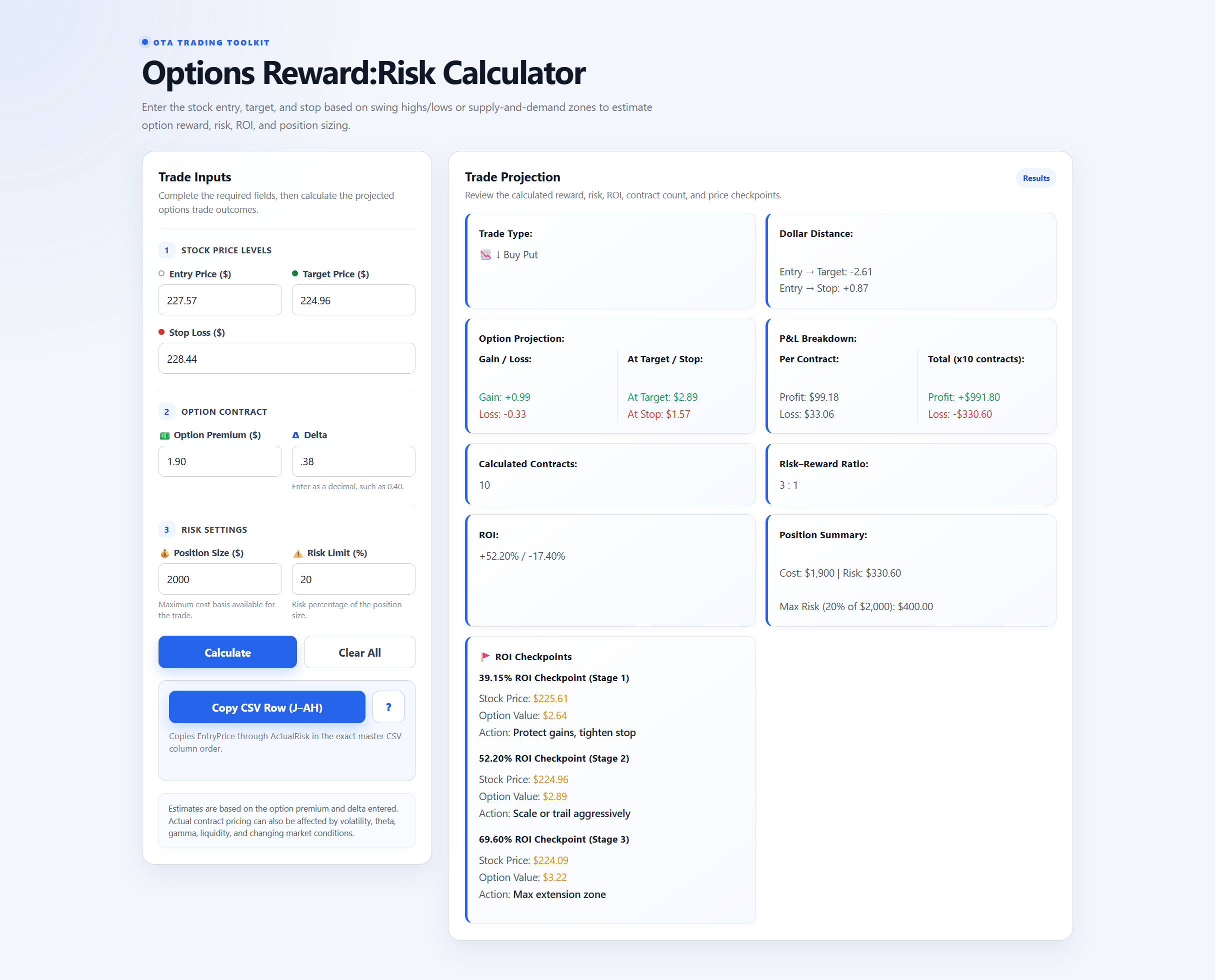
One of the first applications I developed was a browser-based Options Reward:Risk Calculator. Rather than estimating option profitability manually, this application converts a price-based stock setup into projected options risk, reward, ROI, position sizing, and reward-to-risk metrics. It enables traders to evaluate the quality of a trade before entering a position while reinforcing disciplined risk management.
Highlights:
- Interactive HTML application
- Automatic position sizing
- ROI projections
- Risk-to-reward calculations
- Estimated option pricing based on delta
- One-click CSV export for historical trade analysis
- Responsive user interface
Intraday Watchlist Confirmation Table
One challenge I encountered during live trading was maintaining consistency while evaluating multiple stocks simultaneously.
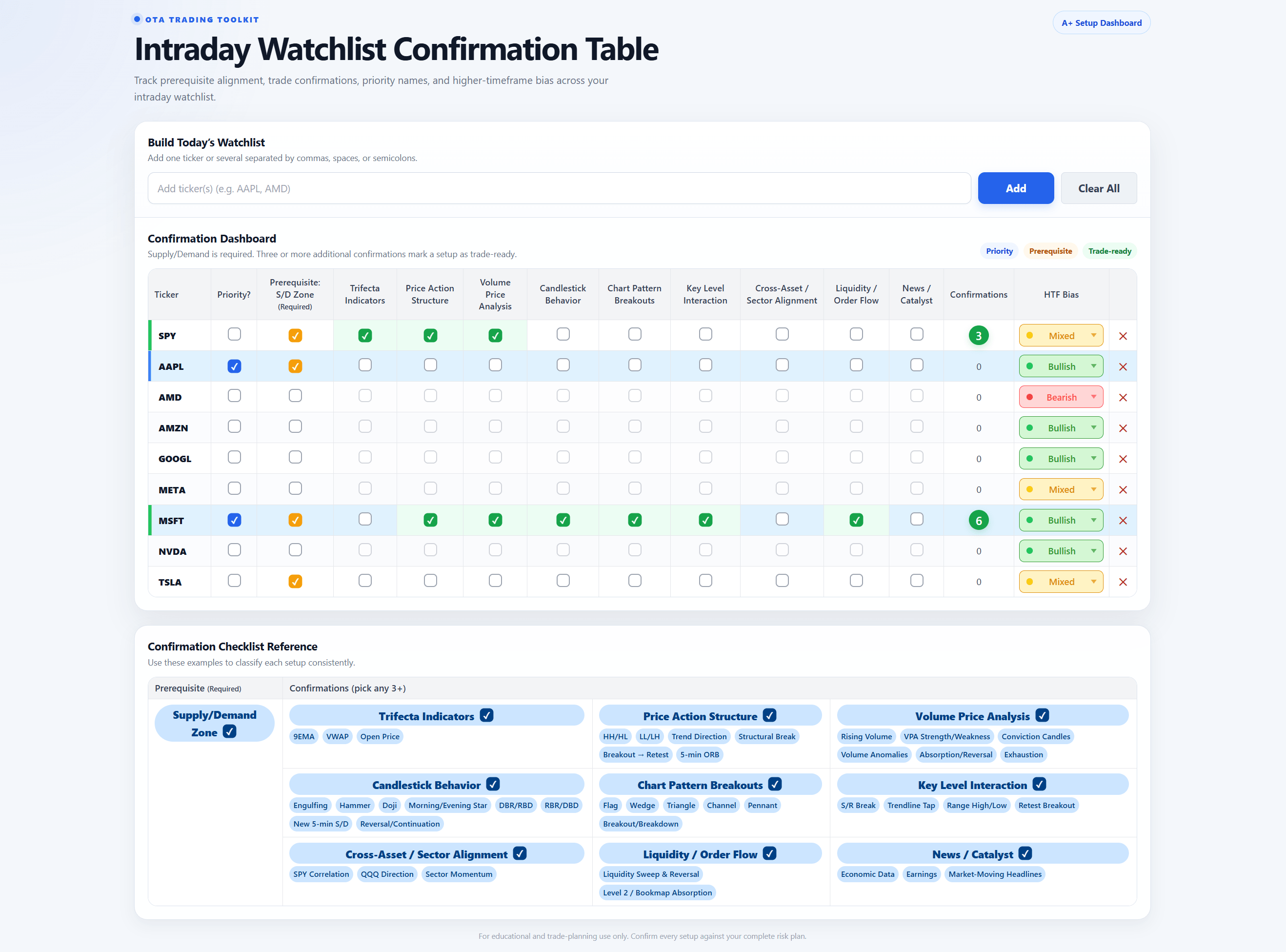
To solve this, I designed an Intraday Watchlist Confirmation Table, a structured decision-support framework that combines higher-timeframe analysis, supply and demand, volume, market structure, and technical confirmations into a single workflow.
Rather than functioning as a signal generator, the table encourages disciplined execution by requiring multiple objective confirmations before a trade is considered.
Highlights:
- Structured decision framework
- Automated confirmation tracking
- Higher-timeframe alignment
- Rule-based trade qualification
ATR Target Calculator
Many traders set unrealistic profit targets that don’t align with a stock’s expected daily movement.
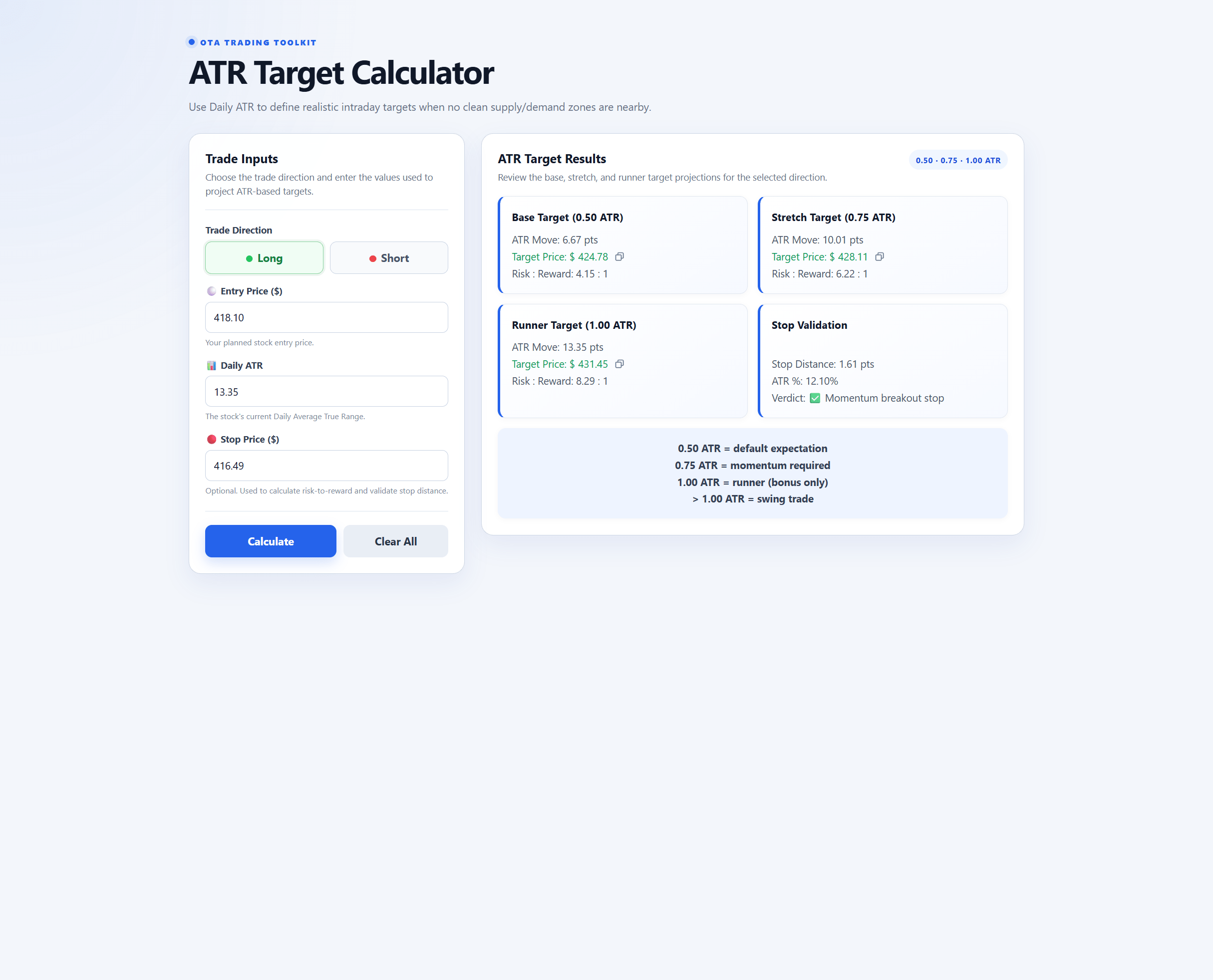
To address this, I developed the ATR Target Calculator, a planning tool that helps establish realistic intraday price objectives using Average True Range (ATR). Rather than predicting price movement, the calculator encourages probability-based thinking by categorizing targets into expectation tiers and validating whether planned stops remain appropriate for day trading.
Highlights:
- Volatility-based target planning
- Risk-to-reward validation
- Stop-size evaluation
- Probability-focused workflow
Options Contract Safety Ratio Calculator
After reviewing my historical trade journal, I noticed that several losing trades exceeded my predefined 20% risk threshold.
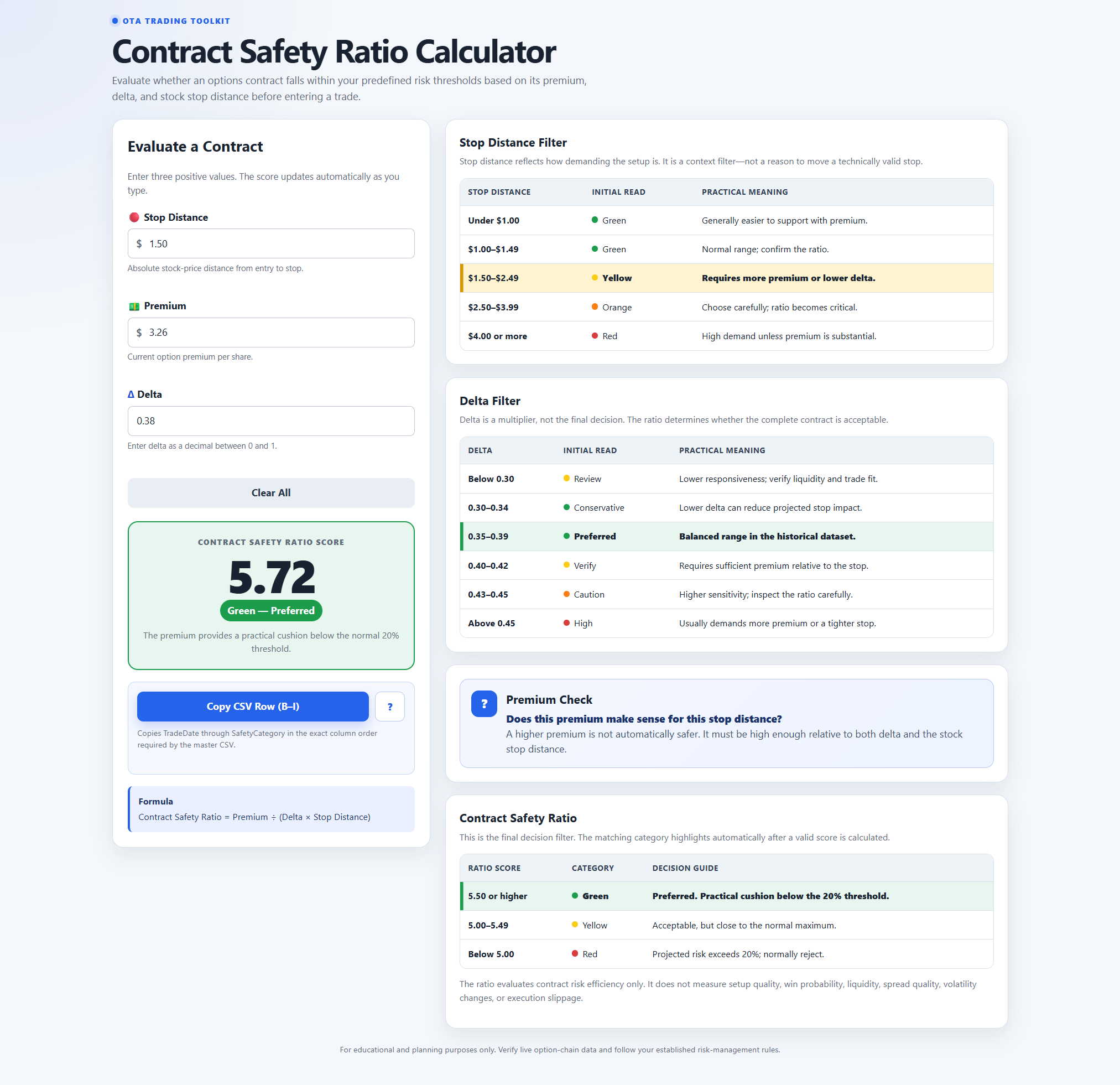
Rather than accepting those losses as isolated events, I analyzed my historical trading data to determine whether a measurable relationship existed between an option’s premium, delta, and planned stock stop distance. This research ultimately led to the development of the Options Contract Safety Ratio.
The calculator acts as a pre-trade screening tool that helps identify option contracts more likely to remain within predefined risk parameters before a position is entered. It also integrates with my Options Reward:Risk Calculator to validate the projected ROI after contract selection, creating a complete decision-support workflow.
Highlights:
- Original risk-scoring heuristic
- Traffic-light risk classification
- Interactive HTML application
- Dynamic table highlighting
- Data-driven contract evaluation
- One-click CSV export for research datasets
- Integrated workflow validation
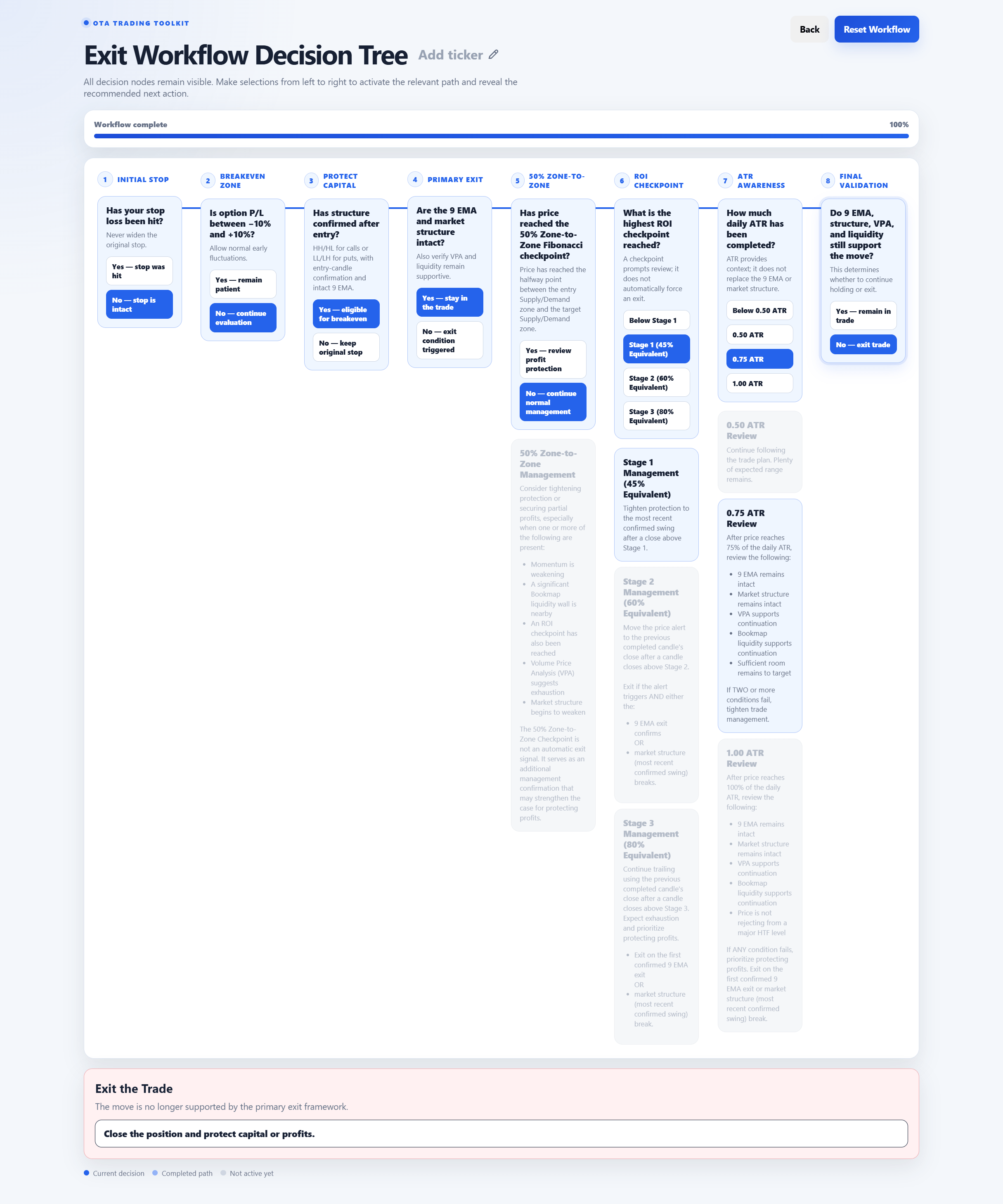
Exit Workflow Decision Tree
One challenge I encountered during live trading was consistently evaluating multiple conditions when deciding whether to continue holding a position, protect profits, or exit.
To solve this, I developed an Exit Workflow Decision Tree, an interactive decision-support tool that transforms a complex set of trading rules into a guided, node-based experience. The application walks users through risk limits, price trends, profit milestones, market momentum, expected price movement, and other market conditions before presenting the appropriate next action.
Rather than relying on a single indicator, the tool brings multiple data points together into a structured workflow. It dynamically tracks user selections, applies conditional logic, activates relevant checkpoints, and automatically guides the user to the next decision.
Highlights:
- Interactive node-based decision workflow
- Complex trading rules translated into a guided user experience
- Dynamic state management and conditional logic
- Responsive auto-navigation between active steps
- Multiple market and risk factors consolidated into one workflow
- Mobile-friendly and accessibility-aware interface
Community Impact
The applications and documentation developed during the mentorship were shared with fellow OTA students to help streamline their trading workflows.
The tools received positive engagement and feedback from both fellow OTA students and my mentor, reinforcing their usefulness beyond my own trading. What began as solutions to challenges I encountered during the program became resources that could also support others facing similar trading decisions.
The screenshots below highlight examples of the community reception, feedback, and discussion generated by these resources.
View the community posts and feedback:
- POST: OTA Full Course Practical Trading Checklist & Cheat Sheet
- POST: OTA Intraday Watchlist Confirmation Table Checklist
- POST: OTA ATR Target Calculator
- POST: OTA Options Contract Safety Ratio Calculator
- POST: OTA Exit Workflow Decision Tree (COMING SOON!)
Trading Framework & Documentation
Beyond front-end development, I created a comprehensive trading framework consisting of structured documentation, daily checklists, planning guides, and review processes that standardized my entire workflow from pre-market preparation through post-market analysis.
These documents helped transform trading from a reactive activity into a repeatable process built around preparation, execution, journaling, and continuous improvement.
Reflection
One of the biggest lessons from this mentorship wasn’t simply learning to trade options—it was learning how to transform complex decision-making into structured, repeatable systems.
By combining quantitative analysis with front-end engineering, I developed tools that reduced manual calculations, reinforced disciplined execution, and converted subjective judgment into objective workflows. As the toolkit evolved, I also designed a standardized CSV export workflow that allows calculated trade data to be captured with a single click and imported into a master research dataset for ongoing analysis and validation. This transformed the applications from standalone calculators into an integrated decision-support system that continuously improves through historical data.
This project represents far more than a trading course—it reflects my passion for building front-end tools that simplifies complex problems and empowers better decision-making.
Graduation
Completing the Options Trading Accelerator marked an important milestone in both my personal and professional growth. Beyond earning the certificate, the mentorship challenged me to think more analytically, build practical front-end solutions, and continuously improve through data and iteration.

Options Trading Accelerator – Certificate of Completion, photographed in front of the New York Stock Exchange on Wall Street, New York City, 2026.
- Category :
Trading
- Date :
Aug . 21 . 2026
- Languages:
HTML5, CSS3, JS
- Platforms/Software:
TradingView / TraderSync / Bookmap
- AI Tools:
ChatGPT
